
H₂S Removal
H₂S (Hydrogen Sulfide) is a dangerous gas that is produced within sewer systems. It is hazardous in low concentrations and becomes flammable and explosive at high concentrations. For those reasons, it is important for operators to have control over H₂S levels and the mechanisms of H₂S production.
H₂S is produced by sulfate-reducing bacteria (SRBs) which convert sulfate (SO₄²⁻) to sulfide (HS⁻/H₂S) within biofilms and sludge. SRBs dominate in zones with reduced oxygen concentrations, where other electron acceptors are used. This process occurs primarily in anaerobic environments, lacking oxygen and nitrates, where fermentation and sulfate reduction dominate.
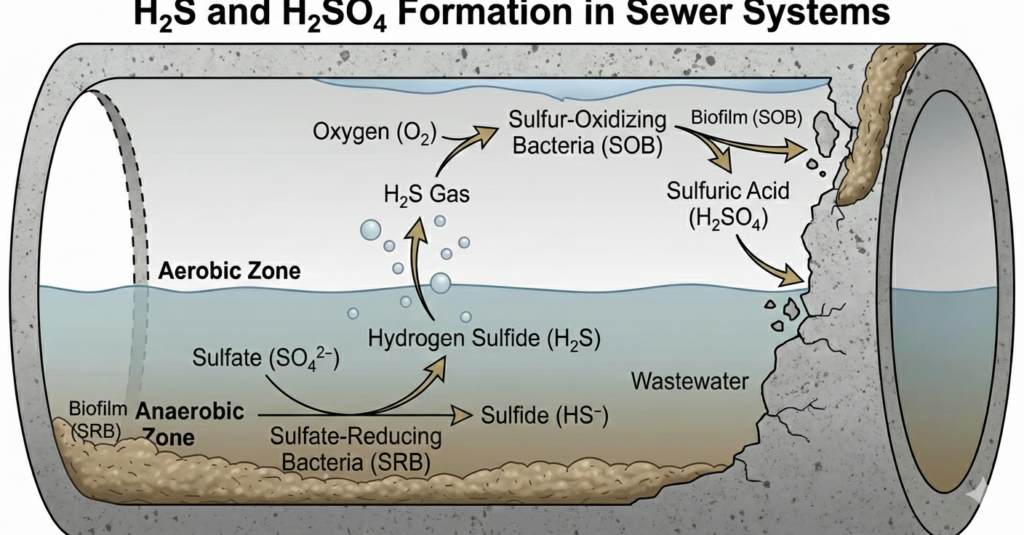
There are many different methods to reduce H₂S concentrations. Our products work using these methods:
- Reduction of FOGs and available Organic Carbon: By decomposing FOGs, the amount of organic material that can be converted into easily degradable products is reduced. This reduces the availability of electron donors that sulfate-reducing bacteria need to reduce sulfate to sulfide (which is a precursor to H₂S). Simultaneously, the biofilm matrix that contributes to anaerobic microenvironments is reduced, further limiting the conditions for H₂S formation.
- Promotion of Sulfur/Sulfide Oxidizing Bacteria: Our product catalyzes the activity of sulfur-oxidizing microorganims that promote the conversion of sulfide (HS⁻/H₂S) to sulfate (SO₄²⁻) and elemental sulfur (S). This counteracts sulfate reduction, thereby reducing H₂S formation in anaerobic zones. In addition, this further weakens the biofilm environments where anaerobic sulfide-reducing bacteria thrive, ensuring a long-term solution for H₂S problems.